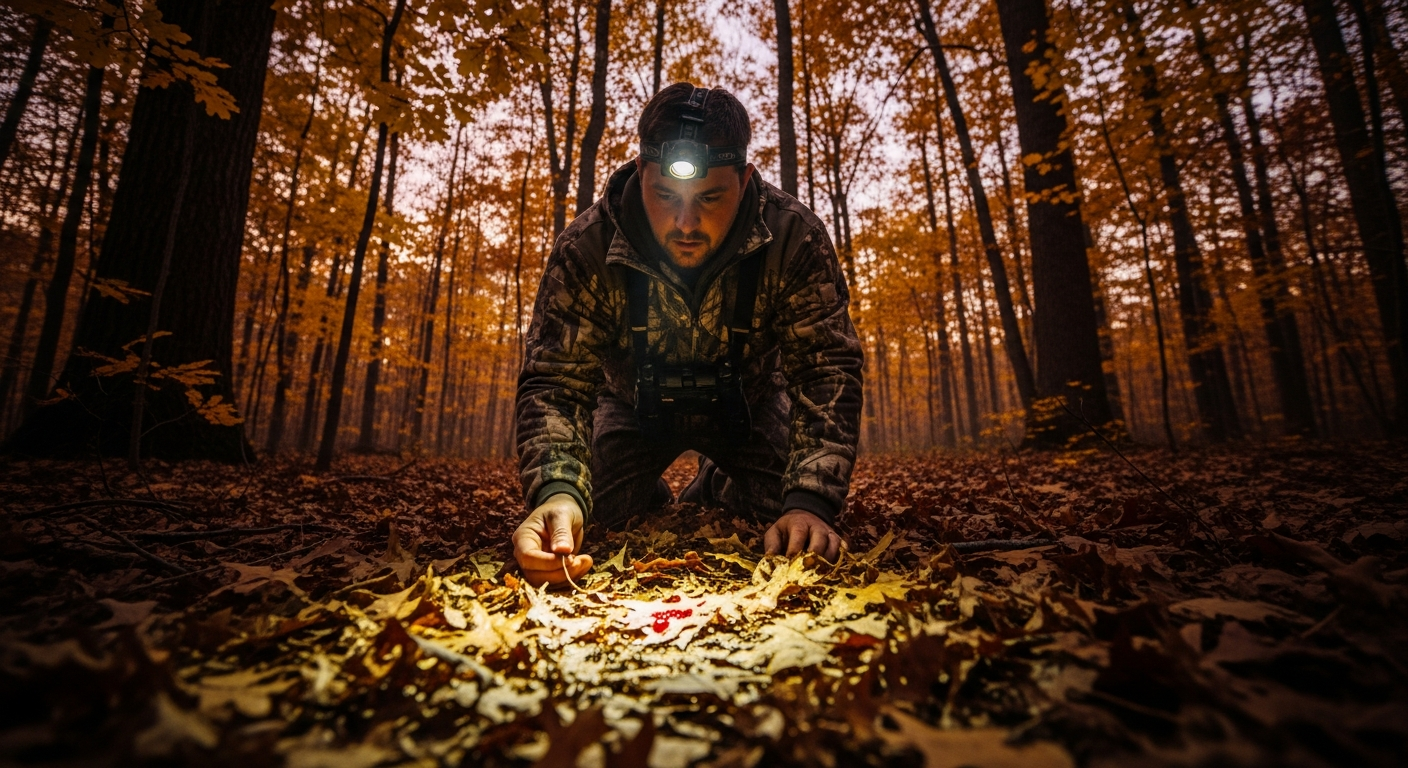
If I could sit every young hunter down around a campfire and pass along everything I've learned over the years about tracking wounded deer, this is exactly what I'd tell them.
Not because I'm the greatest tracker that ever lived.
Far from it.
I've made just about every mistake a deer hunter can make. I've pushed deer I should've left alone. I've followed the wrong trail. I've looked right past blood that was laying in plain sight. I've walked within twenty yards of a dead buck and never knew he was there until daylight.
Every one of those mistakes taught me something.
My hope is they'll teach you without you having to learn them the hard way.
One thing I want you to remember through this entire article is this...
A blood trail is a conversation.
That deer is talking to you every step he takes. Most hunters only listen to the blood. Experienced hunters listen to everything — the tracks, the leaves, the broken branches, the direction of travel, the hair, the smell, the beds. Even the silence. The woods are telling you exactly what happened. Your job is slowing down long enough to hear it.
Before We Ever Follow The First Drop
Now son...
Before you ever take one step toward that blood, I want you to do something that most hunters won't.
Sit down.
I know that's the last thing you want to hear.
Your heart's pounding. Your knees are shaking. You've been waiting all season for this buck. Everything inside you wants to climb down and go find him.
Don't.
This is where more deer are lost than most folks realize. Not because of a bad shot. Because of excitement.
I've watched hunters ruin perfect recoveries because they couldn't sit still another thirty minutes. I've even done it myself.
If you think you're immune to excitement, you're fooling yourself.
Even after all these years, I still have to remind myself to slow down.
While you're sitting there, replay the shot in your mind.
Not the shot you hoped you made.
The shot you actually saw.
- Where was the deer standing?
- Was he quartering away? Broadside?
- Did he duck? Did he wheel? Did he kick? Did he hunch up? Did he tuck his tail?
- Which direction did he leave?
- Did you hear him crash?
- Did another deer react?
Those answers are worth just as much as the blood you're about to find.
Sometimes they're worth more.
The Deer That Changed The Way I Track
Years ago, a buddy and I were hunting a little piece of Florida woods covered in palmettos.
If you've never tracked a deer through palmettos, let me tell you something. They'll test your patience.
That evening he shot a nice eight-point just before dark. The buck mule-kicked, tucked his tail, and disappeared into the thickest mess of palmettos you've ever seen.
We both looked at each other and smiled.
"He's dead."
That's exactly what we believed.
We waited. Climbed down. Walked over to where he'd been standing.
Bright red blood. Not one drop. Several. Just enough to make two hunters feel pretty good about themselves.
For about seventy yards.
Then... nothing.
One tiny speck on a palmetto stem. Twenty feet later... another drop. Then absolutely nothing.
We spread out. Started circling. Started looking harder.
The harder we looked... the less we found.
After about an hour, we weren't tracking a deer anymore.
We were chasing hope.
There's a difference.
Hope doesn't recover deer.
Patience does.
The next morning we came back. Walked no more than sixty yards from where we'd quit the night before.
There he was. Stone dead.
You know what beat us that night? Not the buck. Not the darkness. Not the palmettos.
It was excitement.
We stopped reading what the deer was telling us and started believing what we wanted to believe.
That buck taught me something I'll never forget.
Slow is smooth. Smooth is fast.
I've lived by that ever since.
Blood Doesn't Lie...But It Doesn't Tell The Whole Story
One of the biggest mistakes young hunters make is believing blood alone tells them everything.
It doesn't.
Matter of fact... I've recovered deer with almost no blood at all. I've also followed blood trails that looked like somebody dumped a gallon bucket through the woods only to discover the deer was still on his feet much farther than expected.
Blood is only one clue.
Hair is another. Tracks are another. Bone fragments. The way the deer runs. Whether he heads uphill or downhill. Whether he chooses thick cover. Whether he crosses water.
Every one of those clues matters.
By themselves... not much.
Together... they tell a story.
And that's what you're really tracking.
Not blood.
The story.
Bright Red Blood
Let's talk about the kind of blood every hunter loves to find.
Bright red blood.
I remember the first time I ever found it. I hollered back at my daddy...
"He's dead!"
Daddy never even looked up. He just smiled and said...
"Maybe."
That aggravated me. I remember thinking... "What do you mean maybe? Look at all that blood!"
He finally walked over, knelt beside that first drop and said something I've never forgotten.
"Son...this blood is gonna tell you something...but it ain't gonna tell you everything."
It took me years to understand what he meant.
Bright red blood usually means you've got oxygen-rich blood. A lot of times that's exactly what you want to see — it can indicate a lung hit, sometimes an artery, sometimes a muscle wound that's bleeding well.
That's why I never celebrate based on color alone.
I immediately start asking more questions.
- Is the blood sprayed across leaves?
- Is it dripping straight down?
- Are there tiny bubbles mixed in with it?
- Is it getting heavier? Or lighter?
- What was the deer's reaction?
- Did he slow down? Did he keep running hard? Did he hook toward thick cover?
Those answers matter just as much as the color itself.
One thing I've learned over the years is that a lot of hunters see bright red blood and speed up.
Don't.
That's when you need to slow down even more.
The blood isn't going anywhere.
The clues are.
Pink Frothy Blood
Now let me tell you about my favorite kind of blood to find.
If I walk up to a blood trail and see light pink blood with tiny little bubbles mixed in, my confidence goes way up.
That's usually lung blood. Those little bubbles are air escaping from the lungs and mixing with the blood. Most of the time, that's exactly what you're hoping to find after a good shot.
Now before you go sprinting through the woods... let me stop you right there.
A lot of young hunters think a lung-shot deer is laying fifty yards away every single time.
Sometimes he is.
Sometimes he isn't.
I've seen double-lung deer pile up in forty yards. I've also seen one make it almost two hundred.
Every deer is different.
That's why I still give a lung-shot deer a little time. I've got all night. That deer doesn't know I'm waiting. There's no sense pushing him if I don't have to.
One thing that surprises new hunters is this... some of the best lung shots don't leave much blood for the first twenty or thirty yards.
That catches people off guard. They start second-guessing themselves.
Don't.
Sometimes the chest cavity has to fill before blood starts pouring out the entrance wound. I've watched hunters panic over almost no blood... only to find the best blood trail started thirty yards later.
Again... the deer is writing the story.
Keep reading. Don't stop after the first sentence.
Dark Red Blood
Now let's move on to something that makes a lot of hunters nervous.
Dark red blood.
This is where experience starts paying off.
Dark blood doesn't automatically mean liver. That's probably one of the biggest misunderstandings I hear every deer season.
Dark blood can come from muscle. It can come from veins. It can come from the liver. Sometimes it's simply older blood mixing with dirt and leaves.
That's why I never decide where I hit a deer based on one drop.
Instead, I'm looking at everything together.
- Is the blood thick? Thin?
- Is there very little of it?
- Is the deer walking? Running?
- Did he hunch up?
- Did he bed quickly?
Every answer helps.
Years ago I watched a fellow convince himself he'd made a liver shot because the blood looked dark. Turned out he'd clipped the brisket. That deer lived. The blood fooled him because he quit asking questions.
Don't do that.
Keep gathering clues.
Liver Blood
Now son...
If there's one shot that'll teach you patience... it's a liver shot.
I've seen more deer lost from hunters getting impatient on liver shots than probably any other hit.
Liver blood usually has a deep maroon color. Not always... but most of the time. It often looks thicker than lung blood. Sometimes it'll even have a glossy look to it.
A liver-shot deer usually doesn't know he's dying right away. He'll run. Then he'll slow down. Then, more often than not, he'll head for thick cover and bed.
That's exactly what you want him to do.
Leave him alone.
I've heard hunters say... "I'll just ease in there and see if I can spot him."
Don't.
If he's still alive and you bump him... you just turned a one-hundred-yard recovery into a half-mile tracking job.
I learned that lesson years ago. It wasn't a lesson I enjoyed learning.
Nowadays... if I honestly believe I've hit liver... I back out. I'll drink coffee. I'll eat supper. I'll sit on the tailgate if I have to.
But I give that deer every chance to lay down and expire.
Patience has recovered more liver-shot deer than good tracking ever has.
Gut Shot
Nobody likes talking about gut shots.
But every deer hunter needs to understand them.
If your arrow smells sour... if you find green stomach matter... brown digestive material... or blood mixed with bits of food... slow down.
Way down.
A gut-shot deer can live a surprisingly long time if you push him. He'll often bed within a couple hundred yards. If you leave him alone... many times he'll stay there.
Push him... and he'll get up. Bed again. Get up again. Pretty soon you're chasing him across three properties wondering what happened.
What happened is simple.
You got there before he was ready to die.
That's a hard lesson. But it's one worth remembering.
If I think gut... I'm backing out. No debate.
Muscle Blood
Muscle blood fools a lot of hunters because it often starts out looking pretty good.
You may find plenty of blood for the first fifty or sixty yards. Then it suddenly starts disappearing.
The reason is simple. Muscle bleeds. But muscles also tighten up. The wound begins closing. The bleeding slows.
That doesn't necessarily mean you've lost the deer. It simply means it's time to stop depending entirely on blood.
Now I'm looking harder at tracks. Disturbed leaves. Freshly broken vegetation. The direction of travel. Everything.
Remember... you're tracking the deer. Not just the blood.
When There Isn't Much Blood At All
This one surprises new hunters more than anything.
Some excellent shots hardly leave any blood at first.
Hair plugs the hole. Fat plugs the hole. The entrance wound is high. The blood stays inside the chest cavity until it has somewhere to escape.
I've recovered several deer over the years that left almost no visible blood for the first thirty or forty yards.
If I'd given up because I didn't immediately see a highway of blood... I'd have never found them.
That's why I tell young hunters... never let the amount of blood decide whether your deer is dead.
Let the whole story decide.
Hair Will Tell You Things Blood Never Will
Now we're fixing to talk about something I don't hear many hunters discuss anymore.
Hair.
If I walk up to the place where a deer was standing and I find hair before I find blood... I'm just as interested. Matter of fact... sometimes I'm more interested.
Hair can tell you where you hit that deer before the blood ever has a chance.
Most young hunters grab a handful of hair, glance at it for about three seconds, then throw it on the ground.
Big mistake.
Slow down. Look at it. Feel it. Hair has a story to tell too.
Long White Hair
If you find long, coarse white hair... most of the time you're looking at belly hair.
That usually means one of two things. You shot low... or you grazed underneath him.
Now don't misunderstand me. I've seen low shots still catch the brisket. I've seen belly hair mixed with good blood. That's why I never decide anything from hair alone.
But if all I've got is long white hair... my confidence drops quite a bit. That's when I start looking even harder for blood before I convince myself I've made a fatal hit.
Short Brown Hair
Short brown hair usually comes from the sides. Sometimes the shoulder. Sometimes behind the shoulder.
This is where things get interesting.
Short brown hair with bright lung blood... now I'm smiling.
Short brown hair with dark muscle blood... I'm slowing down and asking more questions.
Hair by itself doesn't tell me where the arrow ended up. It tells me where it first touched the deer.
There's a difference.
Coarse Dark Hair
If you find thick, coarse, dark hair... especially from high on the back... you may have skimmed across the top of the deer.
I've seen arrows shave hair clean off a buck's back without ever entering the chest cavity.
Those are tough nights.
The blood usually starts promising... then disappears. I've learned not to chase those deer all night unless the rest of the clues tell me something different.
Hair Covered In Blood
Now here's something I pay close attention to.
If the hair itself is soaked with blood... I slow down and really study it.
Blood-soaked hair tells me more than dry hair ever will.
- Where's the blood on the hair? Near the roots? Only on the tips?
- Is the blood bright? Dark? Foamy?
Every clue starts fitting together like pieces of a puzzle.
Never rush through the evidence. You'll never get another chance to look at it.
Bone Fragments
Now let's talk about something that'll make your heart skip a beat.
Bone.
Finding little white pieces of bone on the ground can mean several different things. Sometimes you've hit the shoulder blade. Sometimes a leg bone. Sometimes ribs. Occasionally you'll even find tiny chips that came from the spine.
Bone tells me one thing immediately.
The arrow hit something solid.
Now I need to figure out what.
I've recovered deer after shoulder hits. I've also watched shoulder hits end with very little penetration.
Again... the bone doesn't make the decision. It becomes another clue.
Don't Forget To Look Up
Here's something I learned from an old tracker years ago.
He caught me crawling around on my hands and knees looking for blood. He chuckled and said...
"Boy...you're looking in the wrong place."
I looked up at him kind of confused. He pointed toward some knee-high brush.
There were little specks of blood all over the stems. I never would've seen them. I was too busy staring at my boots.
That old man smiled and said something I've never forgotten.
"A wounded deer bleeds wherever his body goes...not just where his feet land."
That changed the way I track forever.
Nowadays... I don't just look down. I look waist high. Chest high. Sometimes eye level.
I've found blood on palmetto stems... tree trunks... briars... tall grass... even hanging from spider webs.
You'd be amazed what you start seeing once you quit staring only at the ground.
When The Blood Starts Getting Better
Here's something that'll surprise a lot of new hunters.
Sometimes... the blood trail actually improves.
I've seen deer leave almost nothing for thirty or forty yards. Then suddenly... blood everywhere.
Most of the time there's a reason. The chest cavity finally filled enough for blood to start pouring out the exit hole. The deer jumped a log. Crossed a ditch. Stumbled.
Every movement changed the way blood escaped.
That's another reason I never panic too early.
A poor blood trail at the beginning doesn't necessarily mean you've made a poor shot.
Keep reading the story. The next chapter may look completely different.
Here's Something I Wish I'd Learned Earlier
Don't ever become so focused on finding blood... that you stop hunting the deer.
That's probably the biggest lesson I've learned after all these years.
I'm watching trails. Escape routes. Creek crossings. Bedding cover. Fresh tracks. Broken brush.
The blood is simply confirming I'm still on the right deer.
If I lose blood... the hunt doesn't stop.
The blood stopped.
The deer didn't.
He's still walking somewhere. He's still leaving clues. And those clues are usually enough to keep you moving in the right direction.
Now... let's talk about the moment every hunter dreads. You take one more step... you look down... and the blood is gone.
That's where most tracking jobs are either won... or lost.
When The Blood Trail Stops
Now we're at the part every deer hunter hates.
You're following the trail... everything's going good... then all of a sudden... nothing.
No blood. No tracks. No broken limbs. Nothing.
I've watched grown men throw their hat on the ground right here. I've watched hunters panic. I've watched them start walking circles all over the woods hoping they'd stumble onto another drop.
Don't.
This is where calm hunters recover deer. Excited hunters usually don't.
The very first thing I do when I lose blood is stop moving.
Not one step.
I stand exactly where I found the last drop. That last drop is the last thing I know for certain. Everything after that is guessing.
Never leave certainty chasing hope.
I've stood perfectly still for five or ten minutes before. Amazing what starts showing itself when you quit walking — a bent weed, a fresh track, one tiny drop on the side of a palmetto stem. The trail you couldn't see while you were moving suddenly becomes obvious.
Patience wins again.
Think Like A Wounded Deer
Here's another lesson an old hunter taught me.
He said... "Quit thinking like a hunter...and start thinking like a hurt deer."
That stuck with me.
A wounded deer usually wants three things. Cover. Security. And somewhere to lay down.
He isn't trying to trick you. He isn't making a plan. He's simply trying to survive.
That's why so many wounded bucks head toward:
- Thick palmettos
- Briar patches
- Creek bottoms
- Pine thickets
- Blowdowns
- Young cutovers
If you've hunted the same property for years, you probably already know where those places are.
Go look there. Not because there's blood. Because that's where deer like to die.
Grid Searching
If I've completely lost the trail, I don't start wandering around.
I grid search.
Slowly. Methodically.
Imagine mowing your yard. Straight lines. Ten or fifteen feet apart. One direction. Then back.
It takes time. But it works.
Most hunters move too fast. They cover too much ground. They walk right past the deer they're looking for.
Slow down. You aren't racing anybody.
Circle Searches
Sometimes I'll circle too. But not giant circles.
Small ones. Ten yards. Then twenty. Then thirty.
Always returning to the last blood.
The farther you get from that last known point, the easier it becomes to start tracking the wrong deer. I've seen it happen — especially when there are several deer together.
Stay disciplined.
Water Changes Everything
Here's something I've seen over and over.
A wounded deer often heads toward water.
Creeks. Ponds. Drainage ditches. Swamps.
Nobody knows exactly why every time. Maybe they're cooling off. Maybe they're following an easy travel route. Maybe they're simply going downhill.
Whatever the reason... I've found a pile of deer within sight of water.
Don't ignore it.
If your deer disappears... check every creek crossing nearby.
Beds Tell You A Lot
Finding a bloody bed is one of the biggest clues you'll ever get.
Don't just glance at it. Study it.
- How much blood? What color? Is there froth?
- Did the deer leave quickly? Or slowly?
- Look at the direction he got up.
That next trail usually tells you whether he's getting weaker... or stronger.
I've watched hunters walk right through a bloody bed because they were so focused on finding the next drop. That bed is part of the story. Read it.
Rain Doesn't Mean It's Over
I've had hunters tell me... "It rained. Guess I'll never find him."
Not necessarily.
Rain makes things harder. No question.
But it doesn't erase tracks. It doesn't erase broken brush. It doesn't erase turned leaves. It doesn't erase beds.
Years ago we recovered a buck after nearly an inch of rain. There wasn't a single visible drop of blood left.
We followed tracks... freshly disturbed leaves... and one snapped briar vine after another.
The blood disappeared. The clues didn't.
When It's Time To Call For Help
There's no shame in asking for another set of eyes.
Matter of fact... some of the smartest hunters I know do it all the time.
Another hunter sees things you miss. A tracking dog can sometimes recover deer that no human ever could.
Don't let pride cost you a deer.
The goal isn't proving how good you are.
The goal is recovering the animal.
That's what ethical hunters do.
Where HuntIQ Fits Into All This
Now let me tell you about something I didn't have thirty years ago.
A few years back, I started fooling around with an app called HuntIQ.
I'll be honest... the first time somebody told me a phone could help find blood, I rolled my eyes. I've been around long enough to see plenty of gimmicks come and go. I figured this would be another one.
Turns out... I was wrong.
What impressed me wasn't that it could help pick up bright red blood. Most hunters can spot bright red blood if they're paying attention.
What impressed me was how it had been programmed to help highlight the wide range of blood colors we actually find in the woods.
- Fresh bright red blood.
- Pink frothy lung blood.
- Dark maroon liver blood.
- Older brownish-red blood.
- Even those tiny diluted spots that almost disappear against pine straw and palmettos.
The app turns everything else into shades of gray while making those reddish colors stand out.
Now let me be perfectly honest... it isn't perfect.
Nothing is.
There are times it'll catch something that isn't blood — a red berry, a leaf reflecting sunlight, a piece of old survey ribbon. That's just the reality of trying to help a phone identify tiny drops of blood in the middle of the woods.
I don't expect perfection. I expect another set of eyes.
And that's exactly how I use it. Not instead of my own experience... alongside it.
Sometimes it'll show me something I missed. Sometimes I'll ignore something it highlights because I know it isn't blood.
The app isn't replacing good judgment. It's supporting it.
That's an important difference.
One review really caught my attention because it sounded exactly like something I'd have done.
Dallas from Alabama wasn't willing to trust the app until he tested it himself. He laid a blood trail through the woods using blood from a butchered steer just to see if the app could actually pick up what he'd missed.
"I set up a blood trail in the woods with some blood from our butchered steer. This dang thing spotted blood I missed. I didn't think this thing would really work, but it did. I'm keeping it. Thanks for the 5-day trial."
— Dallas G., Alabama
I like that review because he wasn't looking to prove the app right. He was trying to prove it wrong. That's exactly the kind of hunter I trust.
After using it myself, HuntIQ has earned a permanent place on my phone. Not because I think technology replaces experience. It never will. But because experience has taught me that another honest set of eyes can sometimes make all the difference.
When Blood Is Hard To See
HuntIQ's Blood Tracker uses your phone camera to help highlight small blood drops that are difficult to see against pine straw, palmettos, and dark leaves.
Try HuntIQ Free for 5 DaysOne Last Thing Before You Go
If you remember nothing else from this article... remember this.
Don't track blood.
Track the deer.
The blood is only one chapter. The deer is writing the whole book.
Read every clue. Slow down. Stay patient. Leave your excitement back at the tree stand.
The woods will tell you exactly what happened... if you'll take the time to listen.
I hope every blood trail you follow this season ends with your hands on the antlers of the deer you worked so hard to hunt.
Good luck this season.
And God bless.
Keep Learning
If this article helped you understand blood tracking a little better, don't stop here. Every recovery is different, and some situations deserve a much deeper explanation than I could cover in one guide.
If you want to become a better deer tracker, I also recommend reading these articles here on HuntIQ:
- How Long Should You Wait After Shooting a Deer? — Knowing when to track and when to wait can make the difference between recovering your buck and pushing him out of the county.
- Deer Shot Placement Guide — Understanding exactly where your arrow or bullet entered the deer helps you predict what you'll find once you begin tracking.
- What To Do When The Blood Trail Stops — Sometimes the blood disappears long before the deer does. This guide explains exactly how I approach those situations.
- Liver Shot Deer Recovery — Probably the hardest lesson patience will ever teach you.
- Gut Shot Deer Recovery — Why backing out is often the smartest decision you'll make all season.
Every one of those situations deserves respect. Every one of them can teach you something.
Final Thoughts
I've spent a lifetime chasing whitetails across hardwood bottoms, pine ridges, oak hammocks, and thick Florida palmettos.
If all those years have taught me anything... it's that the woods are honest. They don't hide the truth. They simply make you work to find it.
Every deer leaves clues. Some leave a lot. Some leave almost none. But they all leave something.
The hunters who consistently recover deer aren't usually the fastest. They aren't always the best shots. They aren't the ones with the most expensive equipment.
They're the ones willing to slow down... pay attention... stay patient... and let the woods tell the story.
If you're a young hunter reading this... don't get discouraged if you lose one. Every experienced deer hunter I know has. Learn from it. Respect the animal. Figure out what happened. Then become a better hunter because of it.
And if you're one of us old-timers... never quit learning. These deer have a funny way of reminding us we're still students.
As for me... I'll keep carrying the lessons those lost bucks taught me. I'll keep looking for one more clue. I'll keep trusting my eyes. And these days... I'll also keep HuntIQ on my phone.
Not because I expect it to replace experience. Experience can't be downloaded. But because it's another tool built by people who understand the hardest part of deer hunting isn't pulling the trigger...
It's making sure the story ends with your hands on that deer.
I hope yours does.
Good luck this season. Hunt hard. Track slow. And never stop learning.
— HuntIQ